
News
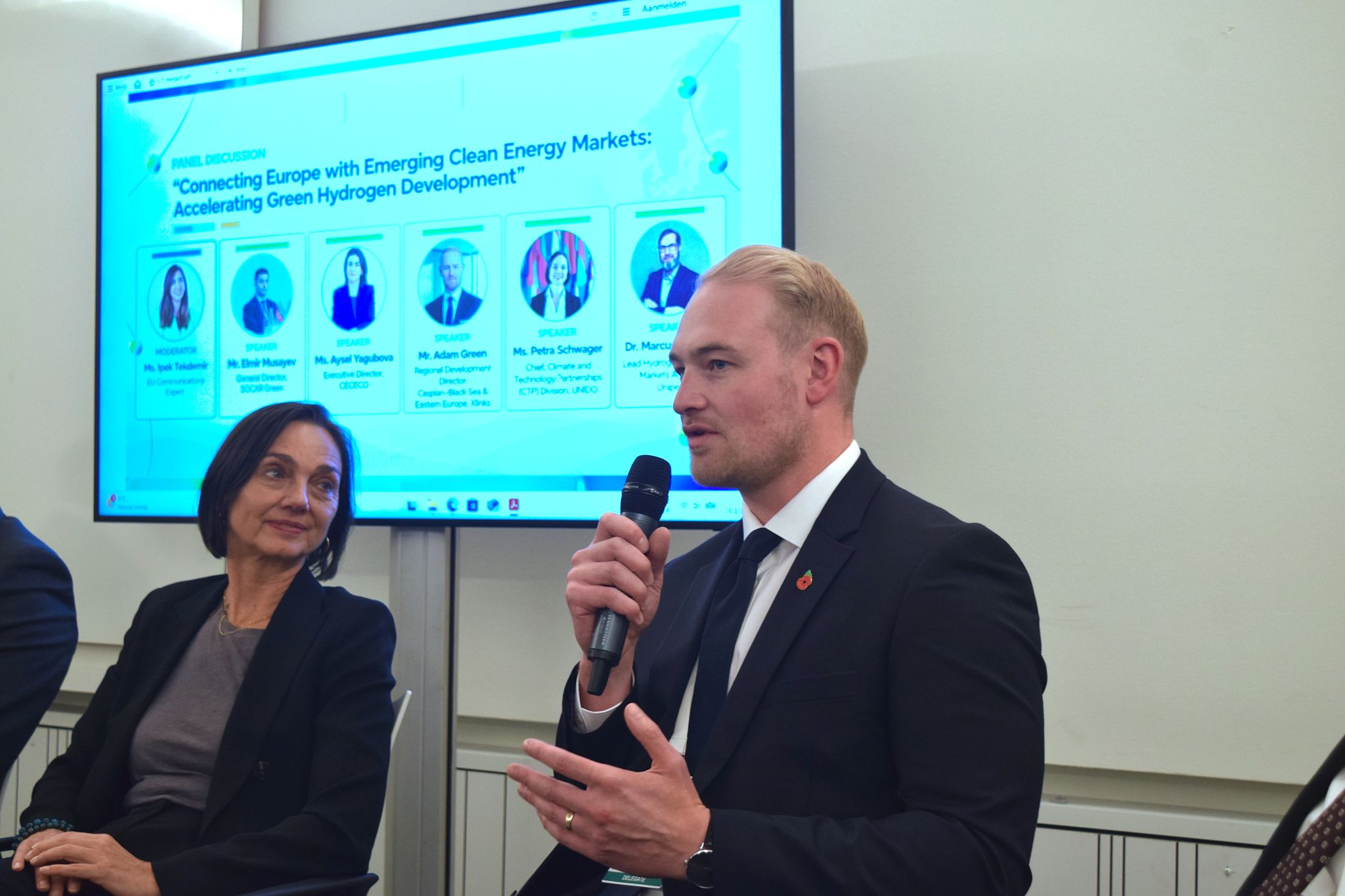
European Hydrogen Week
This week saw European Hydrogen Week in Brussels, where leaders came together to discuss the fight against climate change, and the need to develop a strong European hydrogen supply chain.
Adam Green, Regional Development Director, Caspian, Black Sea & Eastern Europe, joined the panel “Connecting Europe with Emerging Clean Energy Markets: Accelerating Green Hydrogen Development”, alongside Petra Schwager, Climate and Technology Partnerships (CTP) Division Chief at UNIDO, Dr Marcus Kappler, Lead Hydrogen & Energy Markets Analyst at Uniper, Elmir Musayev, General Director of SOCAR Green, and Aysel Yagubova, Executive Director of CECECO.
Our takeaways from the session are that the technology to connect the Caspian and Black Sea regions with Europe already exists. High-voltage direct current links can carry several gigawatts over thousands of kilometres with losses of only a few per cent. The engineering isn’t the barrier. Adam said, “What we need now are bankable intergovernmental frameworks that give investors certainty about who carries which risk over the forty-year life of these assets.”
Hydrogen producers can play a key role as off takers for these green energy corridors, but it must be done efficiently. The starting point should be the customer, not the molecule. Converting electricity to hydrogen and back loses well over half the energy, so where a buyer needs power, the corridor should deliver power.
Green hydrogen earns its place where the end customer actually needs hydrogen or a product made from it, such as steel, fertiliser, chemicals or shipping fuels. Just as the electricity corridors depend on long-term offtake, so does hydrogen. The producer that buys power from the corridor needs its own customers committed through long-term agreements, because those agreements are what make the whole chain bankable.
The corridors also give electrolysers access to a broader mix of renewable supply, which keeps them running for more hours of the year. They give producing countries a choice of export routes too. Done properly, and with coordination across the region, Adam explained that “this approach strengthens Europe’s energy security and keeps more of the industrial value in the countries producing the energy.”